
RESOURCES
Funding guide for deeptech and hardware founders
Funding

From first cheque to first plant: the capital ladder, the VC-vs-project-finance fork, and what to show each investor.
This guide is for founders building physical things, energy, fuels, waste and recycling, maritime, nuclear, industrial tech. Most of them will sooner or later have to build a plant, a production line, or a power station, and discover that the money that got them there will not pay for it.

Hardware does not raise like software
Software startups run a funding track everyone knows by heart: angel money → an accelerator → a venture cheque → more venture cheques → 🦄, or a call from Zuckerberg, whichever comes first. Hardware borrows that track as far as the pilot plant, and then it runs out.
Six years ago I got into the 7th cohort of Entrepreneurs First in Singapore. Six months later about twenty of us graduated with some funds, a private limited company, and went off to raise big money in the open ocean. We landed in very different places: some built their plants, some raised rounds that made it into TechCrunch, some became contributors to the "why startups die" genre. But between us, we had drawn on almost every kind of money you can raise to build hardware, and made every possible mistake in raising it.
The challenge underneath is this: in hardware, Seed → A → B doesn't really mean much. You don't really raise by round letters. You raise by scale: mg → g → kg → tonnes. And the source of money changes at every step, because each step retires a different risk:
Angel and accelerator money turns a design or a PhD into a prototype and proves the technology works, at the scale of milligrams and millilitres.
A grant and a venture round build a pilot plant for the first customers and prove someone will actually use it, now in grams and litres.
And then comes the first full-scale plant or facility, the FOAK (first-of-a-kind), and none of the money that got the company here is built to fund it.
Bring the wrong investor to the wrong step and the answer is "no", on both sides. Not because the technology is weak, but because you are pitching a product they do not sell. The rest of this guide is a map of who sells what, and what each of them needs to see.

The capital ladder: who funds what, at which stage
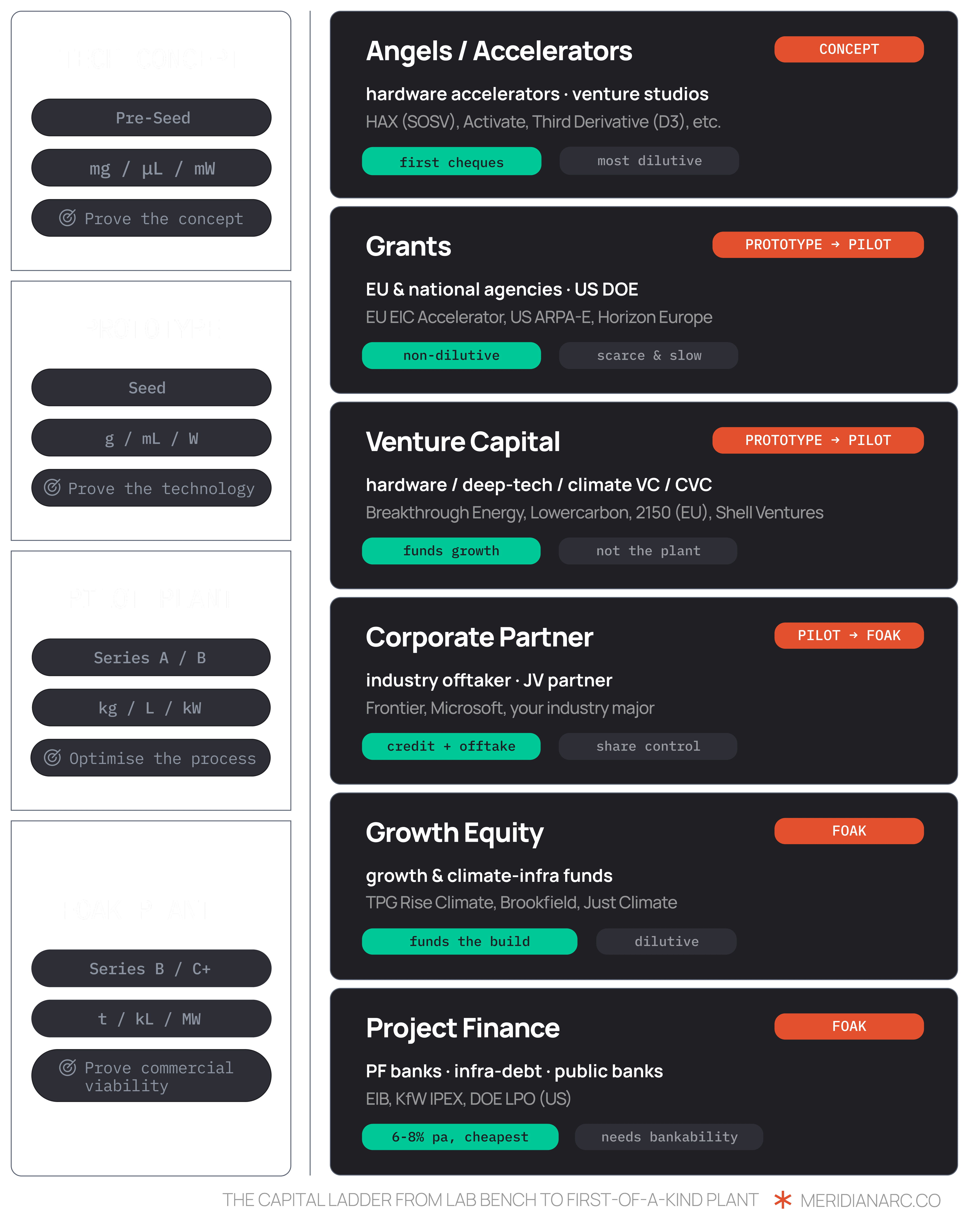
Six sources of capital, in roughly the order you will meet them. Each does one defined job; each has a price.
Angels and accelerators (concept stage, pre-seed). Hardware accelerators, venture studios and fellowships - HAX (SOSV), Third Derivative, Activate - write the first cheques against a design and a founder. Their job is to get you from paper to proof of concept. This is the most dilutive money you will ever take, and it is worth it, because nobody else shows up this early.
Grants (prototype → pilot). Public agencies on both sides of the Atlantic: the EIC Accelerator and Horizon Europe in Europe, ARPA-E in the US, and national programmes almost everywhere. Non-dilutive, and therefore the most fought-over money on the ladder: scarce, slow, and paperwork-heavy. The discipline of a grant application, milestones, budgets, a techno-economic analysis, is itself useful preparation for everything that follows. Treat grants as a co-funder of technical milestones, not as a strategy. The open programmes change constantly, which is why I keep a tracked database of funded pilots and application windows.
Venture capital (prototype → pilot). Hardware, deeptech and climate VCs and corporate VCs - Breakthrough Energy, Lowercarbon, 2150, Shell Ventures. This is the money that builds the company around the technology: the team, the engineering, the pilot line, the first commercial function. What it does not build is the plant, for arithmetic reasons we will get to shortly.
A corporate partner (pilot → FOAK). An industry offtaker or JV partner: Frontier-style buyers, your industry's major. The corporate arrives as sponsor and offtaker at the same time, credit and demand in one counterparty, which is often what makes a first plant financeable at all. The price is control: exclusivity, a share of the asset, offtake on terms it likes.
Growth equity (FOAK). Growth and climate-infrastructure funds - TPG Rise Climate, Brookfield, Just Climate. This is equity sized to actually fund a build, and it is dilutive at the moment your equity is most expensive. Its usual role is to fund the sponsor-equity share of the project that debt will not cover.
Project finance (FOAK onwards). Project-finance banks, infrastructure debt, public banks - EIB, KfW IPEX, the US DOE Loan Programs Office. At 6 to 8% per annum, a base rate plus a margin, this is the cheapest capital on the ladder, and the most demanding: it requires bankability, which is what the second half of this guide is about. One practical note on the public lenders: their programmes open and close on political timetables, so check what is live when you approach, not what was live when someone wrote about it.
A useful way to read the ladder: every rung funds the retirement of a specific risk. Angels fund the question "Does the science work?". Grants and VCs fund "does the technology work at pilot scale, and will anyone use it". Corporates, growth equity and project finance fund "does this exact asset produce, reliably, for fifteen years". If you cannot say which risk a given investor is being asked to retire, you are probably pitching the wrong one.

The fork: venture capital vs project finance
In 2019, I blew my very first meeting with a venture capitalist. I had spent almost a decade before that selling multi-billion-dollar power plants and infrastructure, and my brain was wired for project finance. I lived in equity-to-debt ratios, iron-clad offtake agreements, ROI and payback periods. In that world, a good business is one thing: predictable cashflow. So I pitched my venture exactly that way, multinational clients, real revenue, a strong team, a route to market. The VC's answer:
“We don’t see how this becomes big.”
It took me too long to see there was nothing wrong with the company. I was bringing a project-finance brain to a venture-capital table, selling a de-risked cashflow asset to people who are paid to buy extreme risk and a massive outcome. Fall between the two buckets, and you get funded by neither.
Here is the fork, and it happens to almost everyone reading this. Founders take the first plant to their VCs, and most VCs cannot hold it, not because they dislike hardware, but because their fund arithmetic does not survive it. Large grants exist, but they are scarce and slow. Infrastructure investors, who do fund plants, find a first plant too small a ticket and too unproven. The market calls the resulting chasm the FOAK valley of death.
"Too small" is worth putting numbers on, because it works as a ladder rather than a single threshold. Commercial project-finance banks rarely look below about £100m, since the legal, modelling and independent engineering costs are much the same whatever the size of the deal. Specialist infrastructure debt funds come down to around £50m. Public development banks go lower on paper, and the UK's National Wealth Fund sets a £25m minimum on private investments, while noting that its own deals typically exceed £100m. Below that, the structure is assembled by hand: grants with match funding, a corporate partner's balance sheet, or a small club deal.
And none of these lenders will build the project for you. The National Wealth Fund says so plainly on its own site: it does not develop or bring projects to market itself. Somebody has to, and at this stage that somebody is you.
To most companies the way across is project finance. Instead of raising money against your company, you raise it against the plant itself: the project is held in a separate entity, and the loan is repaid out of the cash that entity is contracted to earn.
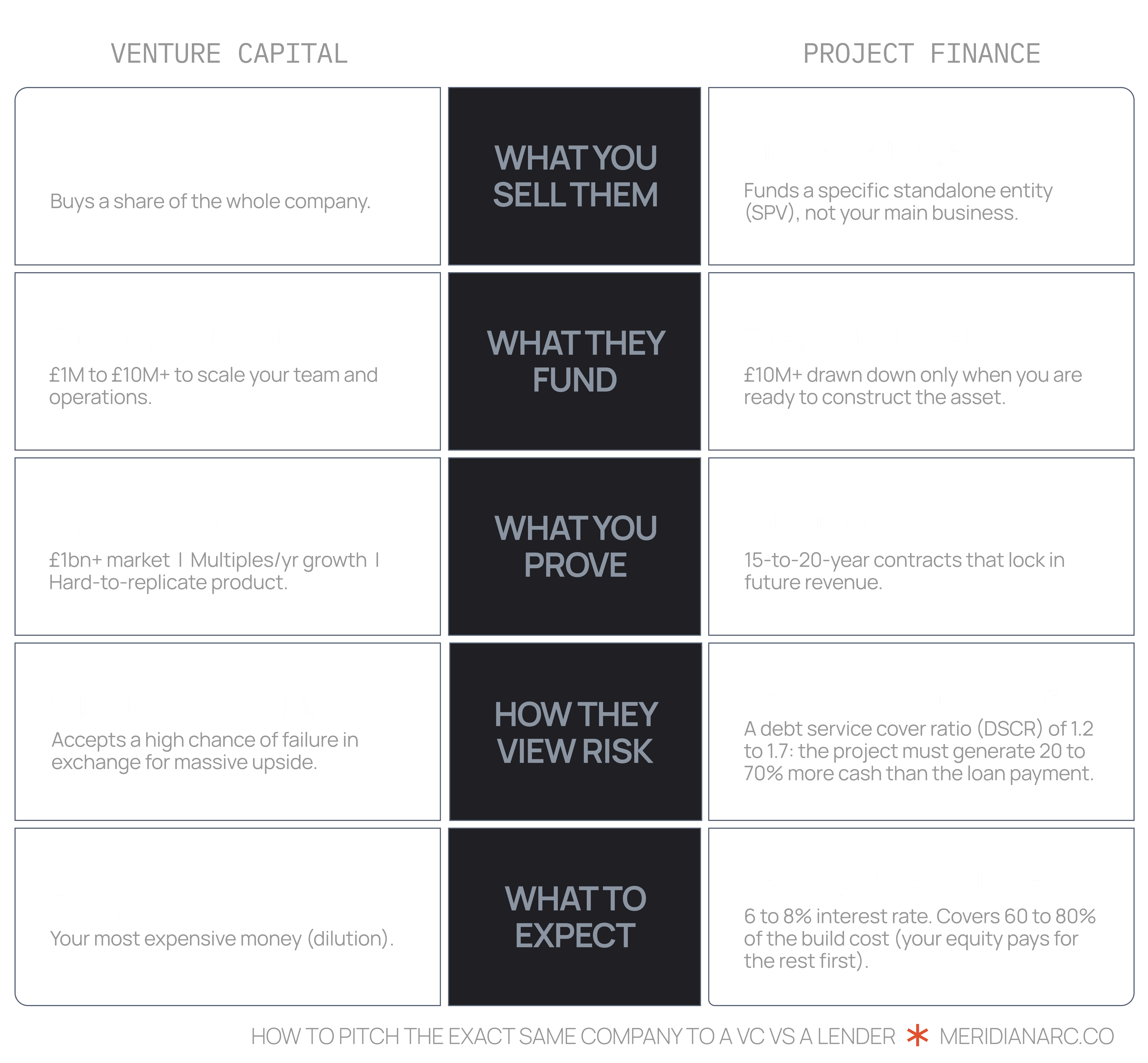
Venture capital and project finance are not two investors with different appetites. They are two different financial products, and a pitch written for one is unreadable to the other.
WHAT IS THE DIFFERENCE BETWEEN VENTURE CAPITAL AND PROJECT FINANCE
Venture capital buys a share of your whole company and accepts technology risk in exchange for the chance of an outsized return. Project finance lends against a single, ring-fenced asset and accepts no technology risk at all. Everything else follows from that split.
WHY VENTURE CAPITAL WILL NOT FUND YOUR FIRST PLANT
A venture fund needs each investment capable of returning a large part of the fund. A £40M facility that reliably yields a project-level return in the low teens is a good asset and a bad venture investment. In hard tech the arithmetic is worse: more rounds, a later exit, and almost no room left in the portfolio for failure. And there is a second problem on your side of the table, the one founders feel later: equity is the most expensive money you will ever raise, and spending it on steel converts your highest-cost capital into your lowest-returning asset.
WHY A LENDER WILL NOT FUND YOUR TECHNOLOGY
A lender's upside is capped at the interest rate, so the downside has to be capped too. The lender is not paid to believe in your technology; the lender is paid 6 to 8% to be almost certain of repayment, which is why the model runs on contracted cashflows and not on potential. Read your own deck through that lens once: a hockey-stick revenue slide, presented to a lender, is not a growth story. It is a risk disclosure.
INVESTABLE IS NOT BANKABLE
Two words get used as though they mean the same thing, and the distinction carries the whole guide. A project is investable when its risk-adjusted return matches an investor's appetite; equity investors accept uncertainty because the upside pays for the ones that fail. A project is bankable when a lender can be nearly certain of repayment from the asset's own contracts, without recourse to your company. Your Series B investor bought investability. The lender will not.
THE ROLE NOBODY WARNS YOU ABOUT
To use project finance, the CEO changes roles: from startup founder to project developer, pitching a different investor, structuring a different entity, packaging the case in a different language. The metrics flip overnight. Yesterday you were rewarded for hockey sticks; today the same slide is a liability. Yesterday "new" was your selling point; today "new" is precisely the thing being underwritten against you. I watched this for years selling nuclear new-build: the technology was rarely the constraint. The financing structure was.
Strictly speaking, there are four ways across the FOAK valley, and only one of them is fully in your hands:
A JV with a strategic. An industrial giant provides CAPEX off its balance sheet and guarantees feedstock; you bring the technology and licence. This is how LanzaTech built its first carbon-to-ethanol plants, in a joint venture with Shougang, on the sites of Chinese steel majors.
Retrofit into an existing facility. Modularise the unit, deploy it inside someone's operating plant, take a revenue share instead of asking for CAPEX. AMP Robotics scaled this way.
Catalytic capital. A mega-grant (DOE, EU Innovation Fund) absorbs the technology risk banks despise; covering up to 60% of relevant costs makes the remainder lendable.
Independent project development. You package the project into an SPV, wrap it in contracts, and raise project finance yourself. The smaller the project, the more of that wrapping you do by hand, because no standard bank template is built for your size.
The first three demand either a paradigm-shattering technology, elite government-relations capability, or a corporate that already trusts you. For most deeptech startups, path 4 is the realistic one, which is why the second half of this guide is a manual for it.
But first: the track you are still on.

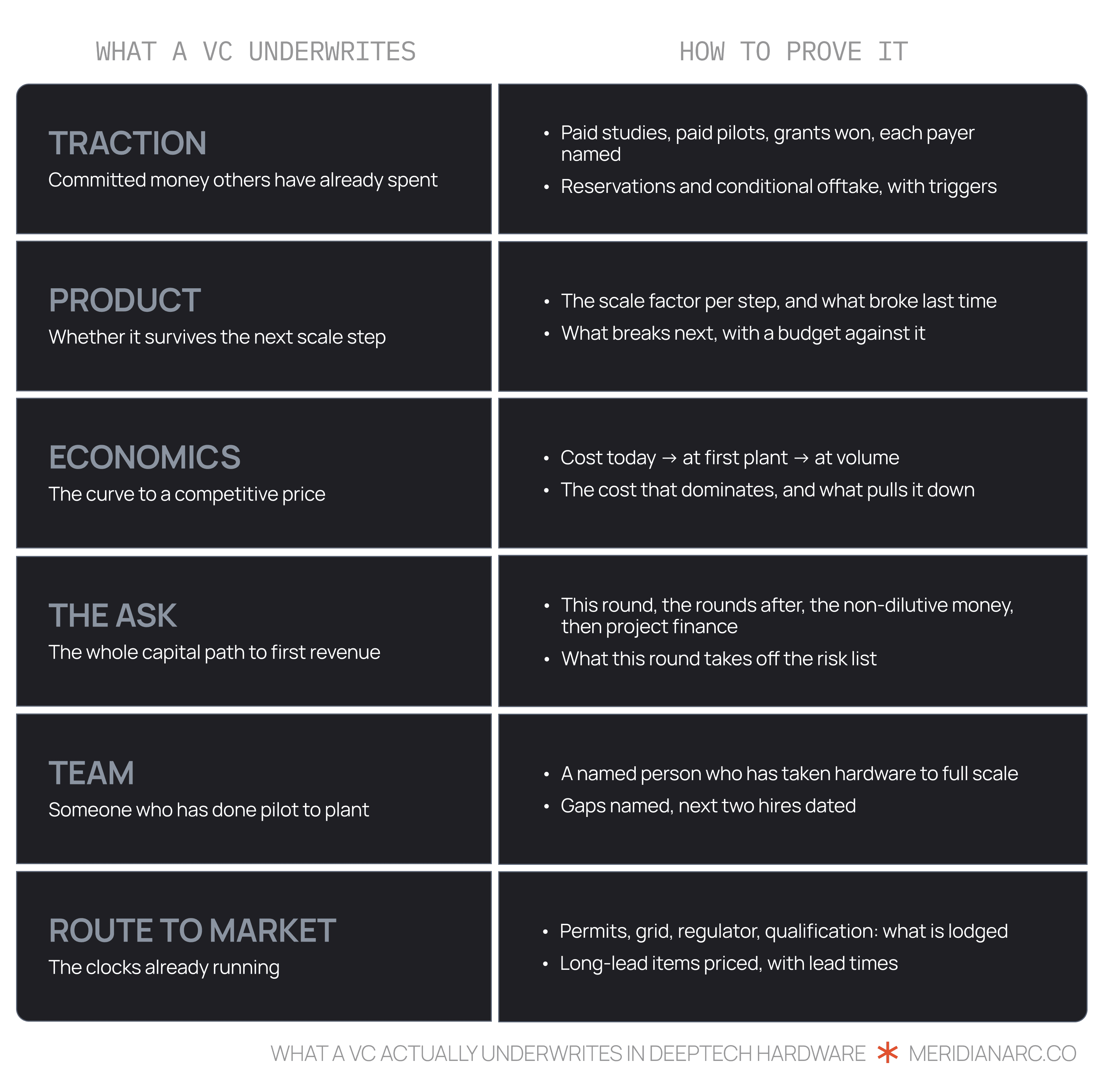
Pitching the VC track: what to show
Until the plant, your job is to be a good venture investment, and that is a discipline of its own. The VC is underwriting one question: can this company become very big, fast, with a defensible edge? Every slide either feeds that question or wastes it.
What follows is the deeptech version of the standard deck. The skeleton is the classic ten; the notes are where hardware founders diverge from the SaaS template.
Cover. Company, one-line essence. If your one-liner needs a chemistry degree, rewrite it.
Problem. A costly, structural problem: regulation tightening, an input disappearing, a cost curve breaking. In deeptech, why now matters more than in software: the answer is usually policy, price, or physics.
Solution and defensibility. What the product does and why it is hard to replicate: IP, know-how, process patents. Spare the reactor internals; state the performance delta and who has verified it.
Business model. How this becomes big. For hardware this slide carries a decision software founders never face: do you sell units, license the technology, or own and operate assets? Each model has a different margin, a different capital need, and, notice, a different exit buyer.
Go-to-market. Who buys first, and the route to them. Name real segments and real buyers, not "industry partnerships".
Market. £1bn+, shown bottom-up: number of units in each segment × your unit revenue. Top-down TAM slides get discounted to zero.
Traction and milestones. Here hardware diverges completely from SaaS. Your traction is not MRR, it is scale-up milestones: mg → g → kg, lab → bench → pilot, TRL steps, hours of continuous operation, third-party validation, pilots with named counterparties, LOIs. Frame every milestone as a risk retired.
Team. Why this team is unfairly qualified: the science, and at least one person who has shipped physical product at scale.
Financials. 3 to 5 year projections, grounded in your techno-economic analysis, not in optimism. Yes, the hockey stick belongs here. This is the one room where it is a growth story.
The ask. Amount, use of funds, and, the deeptech-specific discipline, which risk this round retires and what milestone it buys. "18 months of runway" is not a milestone. "Continuous pilot operation at 1 t/day, unlocking offtake conversations" is.
One more thing that separates fundable deeptech decks from the rest: show that you know the plant is coming. A slide that says
"Series B funds the pilot. The FOAK will be project-financed in an SPV, and here is the de-risking path."
tells a VC you will not come back in three years asking them to fund steel. Sophisticated funds price that in. And it is worth remembering, as you build the deck, that every one of these ten slides is written for an investor who will not fund the plant.

Pitching project finance: how to make your first plant bankable
Ten years ago I was trying to finance small waste-to-energy stations in Asia. We had one unit already built and running in another market, and the plan was to build the second and third out there. To me it was a strong case: the thing worked, we had it running, now we scale. The funds read it the opposite way. One plant running somewhere else was not proof of anything they cared about. What they needed to know was whether this exact design would turn rubbish into electricity, reliably, for fifteen years, and a single first-of-a-kind unit cannot answer that. They were not judging the technology. They were asking whether it was dull and predictable enough to lend against for that long. "New" was not helping me.
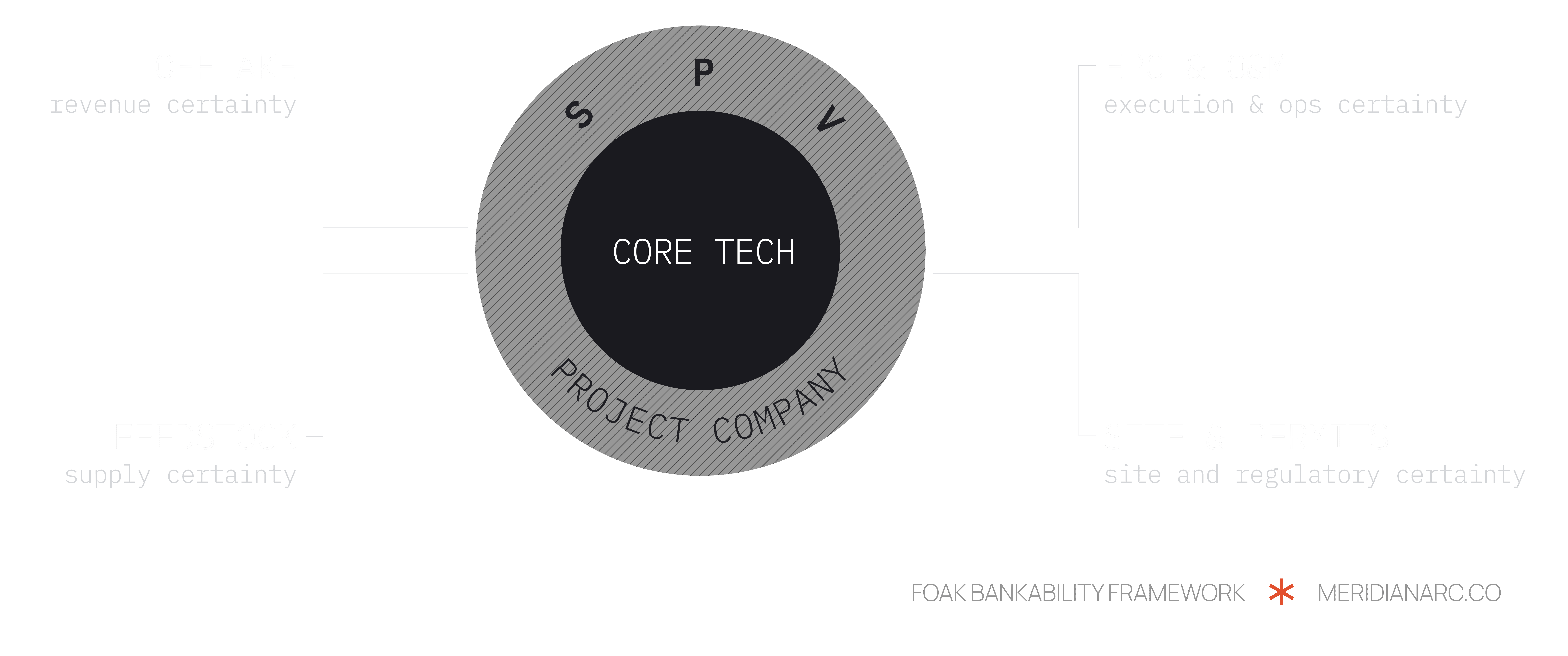
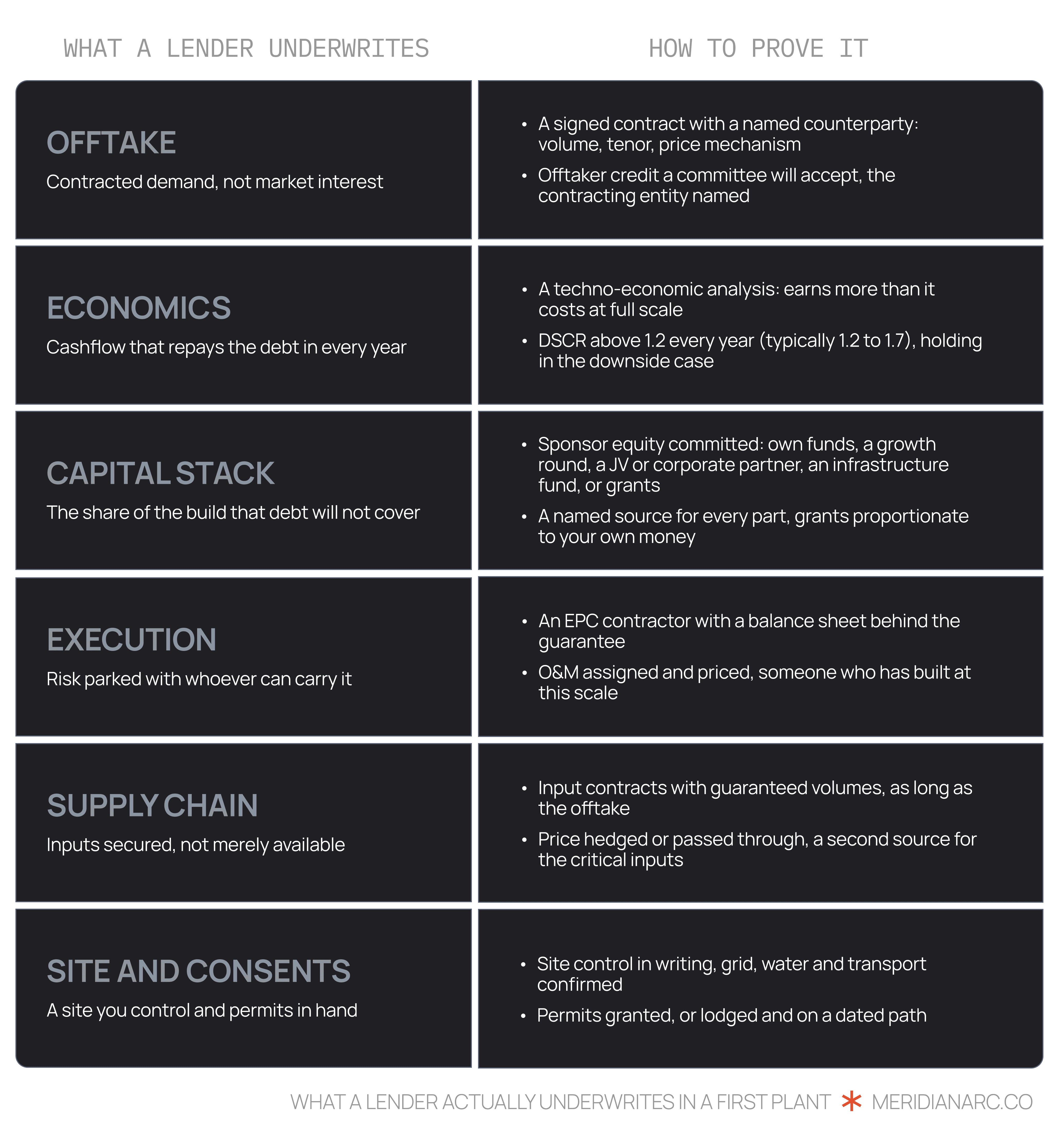
That is the mental model to bring into every lender meeting. Bankability is built across six dimensions, and on each one the founder tends to present what the company has achieved while the lender underwrites something else entirely.
OFFTAKE: MARKET INTEREST IS NOT CONTRACTED DEMAND
Founders show market size and letters of intent. Lenders underwrite contracted capacity, price certainty, and the credit quality of the buyer. A letter of intent is a conversation. A contract is collateral.
What passes: a signed agreement with a named counterparty, not a pipeline of warm ones. Inside it, three numbers do the work. Volume, so the lender knows the plant is sold rather than marketed. Tenor, which should reach at least as far as the loan, because a ten-year contract against a fifteen-year loan leaves five years the lender has to price as merchant risk. And a price mechanism (fixed, indexed, or floored) with an explicit answer to who carries the difference when the market moves.
Then the part founders underprepare: the buyer's credit. The contract is only worth the covenant behind it, so present the offtaker the way a credit committee will read it: the contracting entity named (a subsidiary is not its parent), its rating or financials attached, any parent guarantee spelled out. A blue-chip logo on a slide is not a counterparty. A signed contract with a rated entity is.
ECONOMICS: UNIT ECONOMICS ARE NOT PROJECT RETURNS
Founders show cost per unit and process efficiency. Lenders underwrite the project on its own, inside the SPV, on revenue that is already contracted.
Two pieces of arithmetic do the work. The first is the techno-economic analysis (TEA): what the plant costs to build, what it costs to run each year, how much it produces, and what that output sells for. It answers one question, whether the plant earns more than it costs at full scale rather than at pilot scale, which is the difference between a technology that works and an asset that pays.
The second is the debt service cover ratio, simpler than it sounds. Take the cash the project generates in a year, divide it by the loan payment due that year. Generate £12m against a £10m payment and the ratio is 1.2, a cushion of 20%. Lenders want that cushion in every year of the loan rather than on average across it, because one thin year is a default even when the decade looks fine. Then they run the model again with things going wrong: output at 85% instead of 95%, feedstock 20% dearer, start-up six months late. If the cushion survives that version, the project is financeable. Worth knowing: the loan is usually sized off that downside version, not the one in your deck.
CAPITAL STACK: DEBT IS NEVER THE WHOLE OF IT
Debt covers 60 to 80% of the build. The rest is equity, and the lender's first question is where it comes from and whether it is committed: your own funds, a growth round, a corporate or JV partner putting cash into the project company, an infrastructure fund taking a stake in the asset, or grants.
Grants are the tempting line, because they do not dilute. But proportion matters. A stack that is mostly free public money reads to a credit officer as a sponsor with nothing at risk, and skin in the game is exactly what is being tested. The same logic runs the other way too: as the lender's view of project risk rises, the loan shrinks and your share of the build cost grows. The equity question is settled early, or it settles itself against you.
EXECUTION: A STRONG TEAM IS NOT EXECUTION CAPABILITY
Founders show the team and the pilots. Lenders underwrite track record at scale, EPC partners (engineering, procurement and construction), and O&M capability (operations and maintenance). The question is never whether the team is clever. It is who has built at this scale before, and what happens to the schedule when they slip.
What passes: an EPC contractor with a balance sheet standing behind the construction guarantee, so that cost overruns and delay have an owner other than you. A named operations and maintenance plan, priced, covering who runs the plant on day one and in year ten. And someone on the project who has built at this size, in-house or contracted in. If nobody on your side has, hire that person before the raise rather than after it, because a lender reads the gap faster than any other.
SUPPLY CHAIN: SUPPLIER ACCESS IS NOT SUPPLY SECURITY
Founders show supplier contracts and availability. Lenders underwrite contracted inputs, volume guarantees, price hedging, and resilience. Knowing where to buy feedstock is not the same as being unable to run out of it for twenty years.
What passes: input contracts with guaranteed volumes, running as long as the offtake they feed, so the two ends of the plant are matched rather than one contracted and the other hoped for. Price hedged or passed through on anything that moves the model, because an input you cannot hedge is a margin the lender has to assume will compress. And a second source for anything the plant cannot run without, named and qualified, not a supplier you believe you could find.
SITE AND CONSENTS: A PLAN FOR A SITE IS NOT A SITE
Founders show a shortlist and a target date. Lenders underwrite land you control and permits already granted, because a plant that cannot be built where you say it will be built is a plant with no schedule.
What passes: site control in writing - owned, leased, or optioned - with grid, water and transport access confirmed rather than assumed. A brownfield site carries costs a greenfield does not, so remediation belongs in the build budget from the start. And permits either in hand or on a dated path with the applications lodged. This is the dimension that most often stalls an otherwise financeable project, because everything else can be negotiated and a missing consent can only be waited for.
Capital does not fund technology. It funds contracts.
The capital ladder, the fork, the six dimensions and the two checklists above are simply that sentence, expanded into a work plan.

By Vladimir Chuchkin, Principal, Meridian Arc.
Vladimir contributed as an external expert to The Bankability Test: Unlocking Bank Credit for European Cleantech (I4CE, July 2026), which sets out the lender's side of this question in detail.
This Guide introduces the core principles that power my broader suite of advisory services, including Capital Action Plan and bespoke services.

FAQ
01
Can venture capital fund a factory or a plant?
02
What is the difference between an investable project and a bankable one?
03
What is an offtake agreement?
04
What debt service cover ratio do project finance lenders require?
05
How much equity do I need for a project finance loan?
06
How large does a project need to be for project finance to work?
07
When should a company approach project finance?
08